

The AI Listing Photo Rules Every Chicagoland Realtor Needs to Know
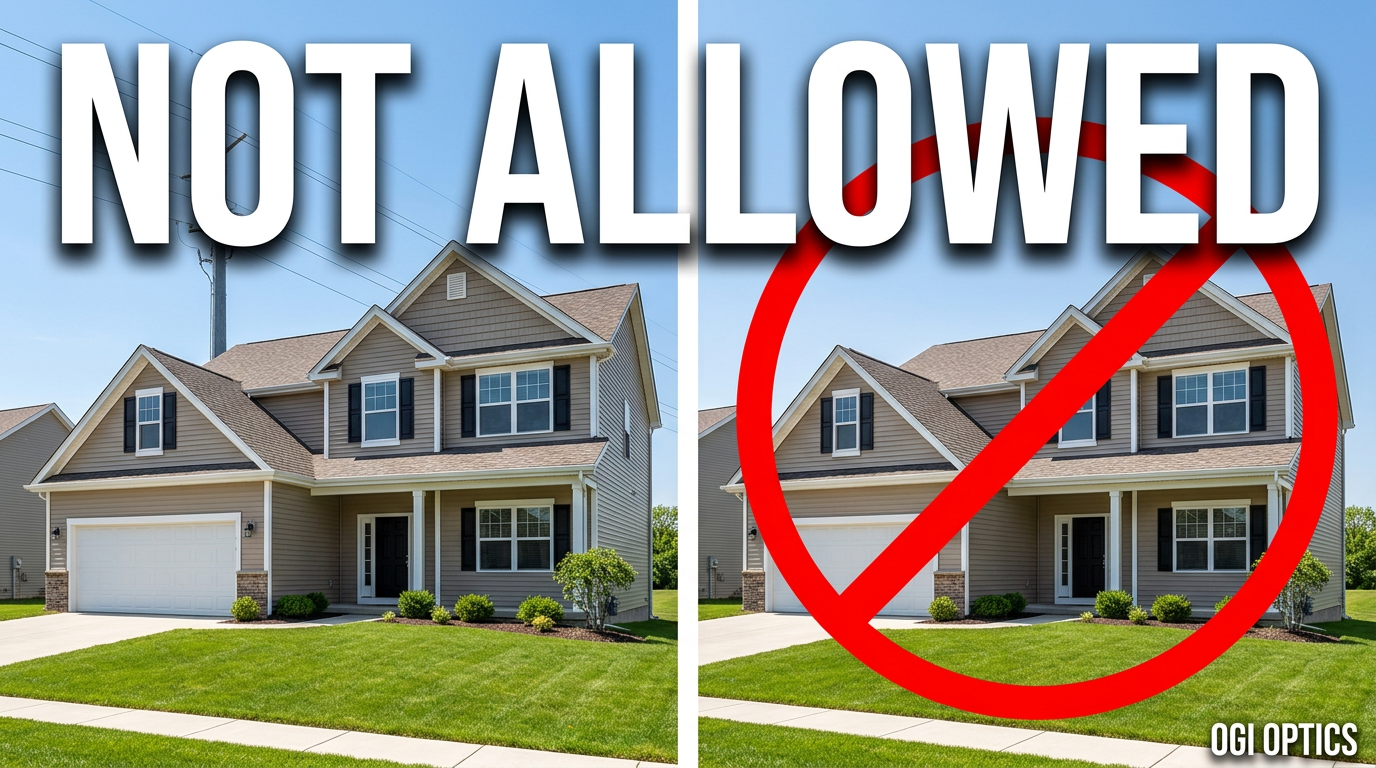
Two years ago, removing a power line from a listing photo or filling an empty room with furniture took real Photoshop skill and a professional who knew what they were doing. Today it takes an app and about thirty seconds.
That shift is the whole story. When a capability goes from specialist-only to available-to-everyone overnight, plenty of agents start making edits without fully understanding the weight of them — usually with no bad intent at all, just someone trying to make a listing look its best.
The rules did not disappear, though. They tightened. In Season 2, Episode 2 of Shoot to Sell, we break down exactly where the line sits.
What Was Covered
The three layers of rules that stack
There is no single federal rule governing AI-edited listing photos — no FTC regulation, no national MLS. Obligations layer on top of one another, and if any one applies, all of them do.
The first layer is the NAR Code of Ethics. Article 12 requires REALTORS to present a true picture in their advertising and marketing. Standard of Practice 12-5 extends that directly to digital images, requiring disclosure when a photograph has been altered in a way that materially changes what the property looks like. Standard 12-10, adopted back in 2018, prohibits manipulating listing content to produce a deceptive result and specifically bars misleading images.
The second layer is MLS board rules. Every major MLS in the country permits virtual staging with disclosure, but the mechanics vary — some require a watermark on the image, some require disclosure in the public remarks, some require both, and some require the original unaltered photo be uploaded alongside the edited one.
The third layer is state law, and it is the one changing fastest. California's AB 723 took effect January 1, 2026 and is the first state statute written specifically about digitally altered and AI-edited listing photos, requiring a conspicuous notice on or near the image plus a link back to the original. Illinois has no equivalent statute yet — but 38 states now have some form of explicit virtual staging disclosure requirement, up from 22 in 2023. The direction is not ambiguous.
Enhancement is not alteration
Most agents get stuck because they think the question is whether AI was used. It isn't. The question is whether the edit materially changed what the property looks like.
Exposure correction, white balance, lens distortion correction, perspective straightening, and HDR blending are enhancement. They have been standard in professional real estate photography for two decades and require no disclosure.
Adding furniture to an empty room, day-to-dusk twilight conversion, sky replacement, and changing wall colors or flooring are material alterations. All of them get disclosed. The same standard that applies to virtual staging applies to twilight editing and sky replacement — if the photo shows something the property does not actually look like, it gets labeled.
The third category most agents miss
Disclosure does not make everything acceptable, and this is where otherwise careful agents get caught.
Removing defects or damage, removing permanent fixtures, editing out power lines or fire hydrants, altering walls or windows, changing the dimensions of a space, or enhancing landscaping past its actual condition are not permitted at all — regardless of how clearly you label them. These edits misrepresent the property's actual condition rather than helping a buyer visualize potential, and no amount of disclosure cures that.
The clean test: does the edit help a buyer imagine what they could do with the space, or does it hide what is already there? The first is generally permitted with disclosure. The second is not permitted at all.
Adding versus removing — the distinction nobody explains
This one deserves its own section because it catches good agents off guard.
Virtual staging on a vacant room is permitted by every major MLS board with disclosure. It is well established, buyers understand it, and it is not considered misleading because an empty room genuinely could hold that furniture.
Digitally removing furniture that is currently in the property is treated differently. Most MLS boards and NAR guidance recommend against digitally replacing or removing existing furniture, on the reasoning that it misrepresents the property's actual condition. The prevailing best-practice standard is that virtual staging should add furniture to vacant spaces rather than alter what already exists.
The practical read for occupied listings: decluttering-style edits sit in a much grayer zone than virtual staging on a vacant room. If you use them, disclose them clearly, keep the original file, confirm your board permits it, and never use them to hide a defect or the true condition of a space.
The safer path on an occupied listing has not changed — prep the room before the shoot. Ten minutes of moving things out of frame produces a photo with no compliance question attached to it at all.
What this means in Chicagoland
MRED permits virtually staged photos with disclosure citing the virtual edits and any non-conveying items added. Illinois is generally categorized as a moderate disclosure state, requiring listing description disclosure. Agents should confirm current MRED requirements on per-image watermarking directly, since board rules are updated periodically.
The practical checklist for a Chicagoland listing:
Disclose digitally altered photos in the listing remarks, near the top rather than buried at the bottom
Use explicit language — "virtually staged" or "digitally enhanced" — not vague phrasing
Keep the original unaltered photo, same camera position, same frame
Include at least one unaltered photo of any room that appears in altered form
Never edit out a defect, a fixture, or anything that changes the property's actual condition
Confirm current MRED requirements before you list
One note on originals worth understanding: the pre-edit file needs to be the same image, from the same camera position, that became the altered version. Tools that edit the input photograph satisfy this. Tools that generate a room from scratch based on a text prompt do not, because there is no original to produce.
Why this is a competitive advantage, not a burden
It is tempting to read all of this as a list of restrictions. It is more useful to read it as a differentiator.
A meaningful number of agents are currently using AI editing tools without disclosure — either because they do not know the rules or because they assume nobody checks. That creates real exposure: listings can be pulled until resolved, complaints can be filed with the state real estate commission, and failure to disclose can be construed as misrepresentation in a transaction dispute.
It also creates an opening. An agent who uses AI enhancement openly, discloses it clearly, and lets the quality of the work speak for itself is signaling something to sellers that is genuinely hard to fake.
Buyers are far less bothered by disclosed enhancement than agents expect. Virtual staging has been disclosed on listings for years without hurting performance. What damages trust is not the disclosure — it is arriving at a showing and realizing the photos were not honest.
The agents who get in trouble are the ones trying to pass AI-edited photos off as untouched photography. The agents who win are the ones doing it openly.
Why This Approach Works
Compliance content usually gets written one of two ways: as a scare piece, or as a wall of citations nobody finishes. Neither helps an agent decide what to do on Tuesday morning.
This episode sorts every common edit into three plain categories — no disclosure needed, disclosure required, never permitted — and gives a single test an agent can apply to anything not on the list. That is the difference between knowing the rules exist and being able to use them.
Watch Season 2, Episode 2
👉 Watch Shoot to Sell — Season 2, Episode 2 on YouTube
Every enhanced image Ogi Optics delivers comes with the original file preserved and clear guidance on how to disclose it. Visit ogioptics.com or follow @ogioptics to book your shoot.
A Note on This Guidance
This is a practical overview based on published MLS rules, NAR Code of Ethics provisions, and current state legislation as of August 2026. It is not legal advice. MLS rules vary by board and change periodically — confirm current requirements with MRED and your managing broker before relying on any of it for a specific listing.