


A Homebuyer Wants the Kitchen. An Investor Wants the Meters.
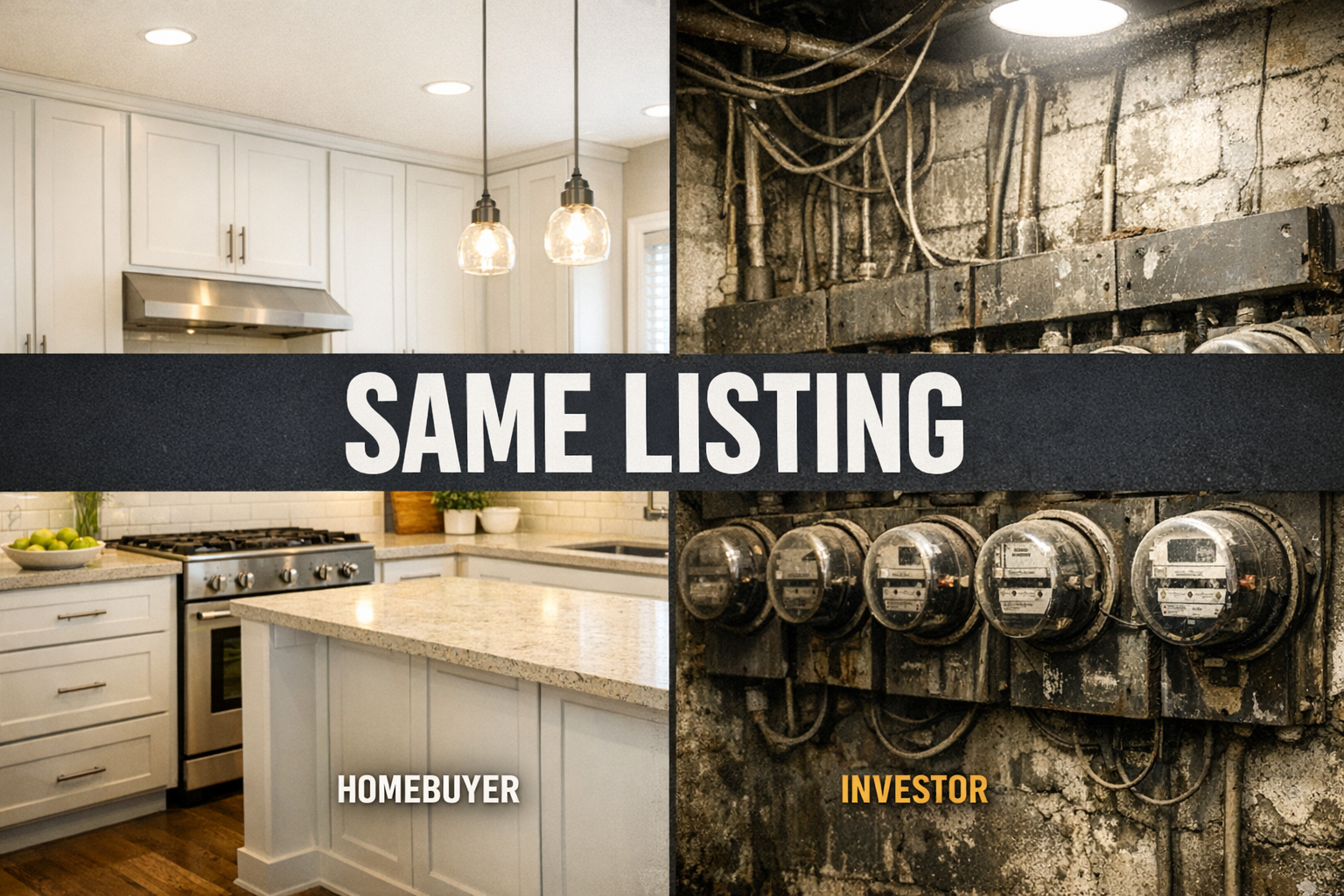
A homebuyer wants to see the kitchen. An investor wants to see the meters.
That sounds like a small difference. It isn't. It changes the entire photo set, and almost nobody shoots for it.
Watch this week's episode: A homebuyer wants the kitchen. An investor wants the meters.
The template was built for a buyer who isn't there
Every convention in listing photography assumes an owner-occupant. Lead with the kitchen. Stage the living room. Get the primary suite. Twenty-five frames, most of them interiors.
That's correct for the vast majority of listings, and we shoot it that way constantly.
Now put that template on a two flat. Or a three flat, or a four flat.
The person writing that offer is not moving in. They're buying an income stream attached to a maintenance liability, and they're trying to work out what both of those are going to cost them over the next ten years. Almost none of what they need to know is inside a unit.
What an investor is actually pricing
The building envelope. Brick, roofline, gutters, porches, back stairs. On a hundred-year-old building that's where the condition story lives, and it's the biggest number in the buyer's head. A roof is not a decorating problem.
The number of doors. Separate entrances — front, rear, basement. That's how a buyer understands whether the building functions the way the listing says it does.
The meters. Whether the units are separately metered or the owner is paying the heat is a real line item that moves the return calculation. One photograph answers it. Most listings don't include that photograph.
The parking. Spaces are income, not amenity.
The block. An investor is underwriting a neighborhood, not a house. That's an aerial or a wide street-level frame, and it's doing more work than any interior in the set.
The photograph nobody takes
If you shoot small multifamily and take one thing from this, take the meter bank.
It's an unglamorous photo of a basement wall. It will never be the lead image. And it silently answers a question that changes the math on the whole deal — because owner-paid utilities on a four flat is thousands of dollars a year off the bottom line, and a buyer who can't confirm it either asks or assumes.
Assumptions get priced conservatively. Every time.
Why the floor plan matters most here
On a tenant-occupied building you frequently cannot get into every unit. Tenants have rights, notice requirements are real, and some people simply say no.
We shot a four flat this week and got access to two. That's normal. It isn't a failure of the shoot and it shouldn't be treated as one.
But it does mean the floor plan is carrying more weight than usual. It's the only way a buyer understands the two units they're never going to walk — the layout, the room count, whether the footprint matches what the listing claims.
On a single-family listing the floor plan is a strong addition. On a tenant-occupied multifamily it's closer to essential.
Why nobody has written this down
Here's the part worth saying plainly.
Nearly everything published about multifamily photography is written for two-hundred-unit complexes. Shoot the clubhouse. Stage the model unit. Get the amenity deck and the pool.
None of that exists on a 1923 four flat in Calumet Heights — and that building is the entry point for almost every new investor in this city. Small multifamily is where people start, it's a large share of the inventory across Chicago's south and west sides, and the photography advice for it essentially doesn't exist.
So it gets shot with a template built for the wrong buyer, and everybody involved assumes that's just how listing photos look.
The short version
The standard photo set is built for somebody who is going to live there. On a two flat, that person doesn't exist.
Shoot the building, not just the units. Count the doors. Take the meter photo. Get the block from the air. And put a floor plan on it, because you probably didn't get into every unit and neither will the buyer.
Frequently asked questions
How much does real estate photography cost in Chicagoland? Our Base package starts at $200 and includes 25 MLS photos, 6 drone photos and a floor plan. The Plus package at $300 adds a property walkthrough and basic cinematic video. Our Pro package at $450 includes a full cinematic video. Multi-unit buildings are quoted based on unit count and access.
Do you shoot investment and multifamily properties? Yes. Two to four unit buildings, small apartment buildings and mixed-use. We shoot for the buyer who's underwriting the building, not just the units.
How fast do you deliver photos and video? Standard turnaround is 24 to 48 hours for photos and 48 to 72 hours for video.
What areas do you serve? We work throughout Chicago and the surrounding suburbs, including the south and west sides, Calumet Heights, South Shore, Berwyn, Cicero, Schaumburg, Arlington Heights and Elgin.
Book a shoot on your next multifamily
If you're listing a 2-4 unit and you want it photographed for the person actually buying it, that's what we do.
See packages and book a shoot →
Related: There's No MLS Field for "Looks at Water" — why the things that matter most usually have nowhere to live in the listing data.