

There's No MLS Field for "Looks at Water"
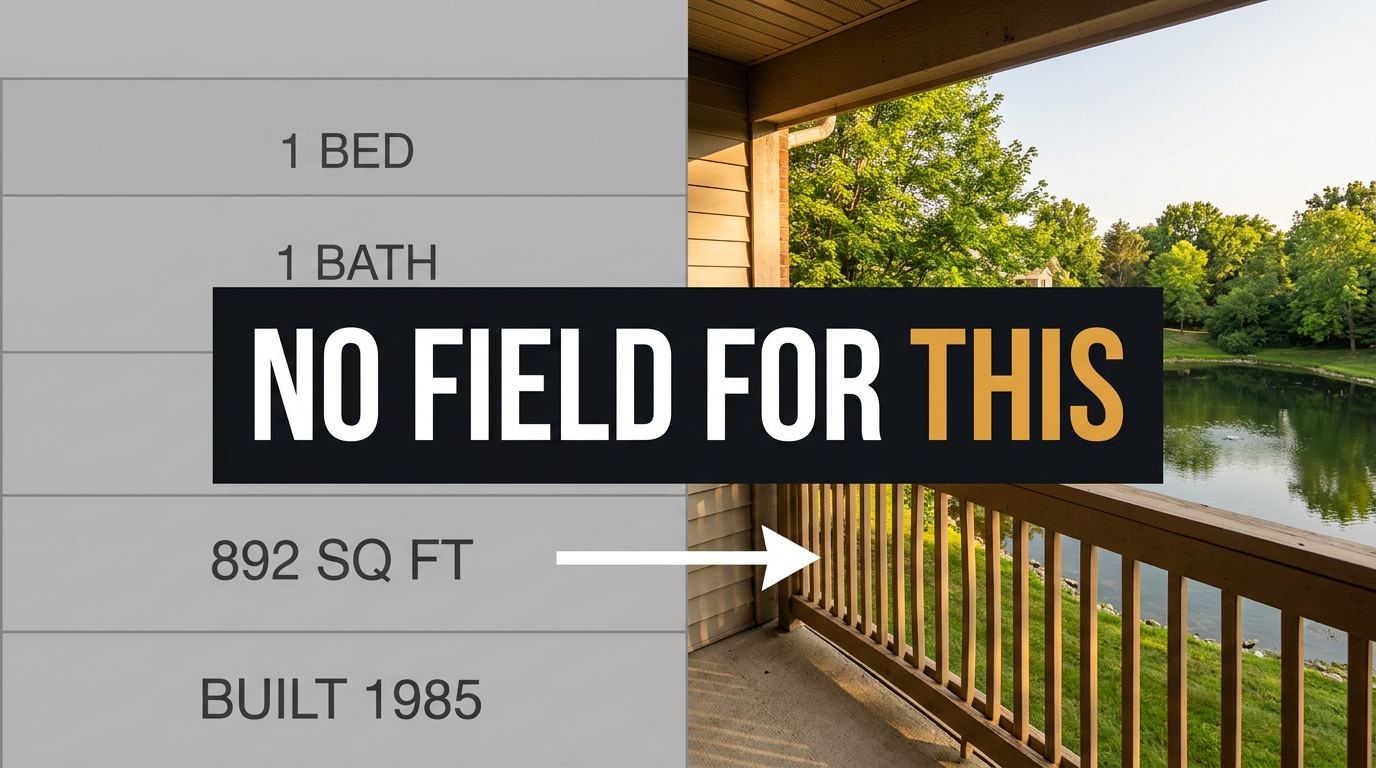
There's an MLS field for bedrooms. For bathrooms, square footage, year built, parking, assessment amount, and about two hundred other things.
There is no field for the balcony looks at water.
There's no field for the kitchen was gutted last year, or the afternoon light in the living room is the reason someone will fall in love with this place. Those facts exist. They're often the most important facts about a property. And there is nowhere in the structured data to put them.
That gap is the entire reason photography is worth paying for, and it's worth understanding precisely.
An MLS listing is doing two jobs at once
The first job is being a database record.
Structured fields are what search engines, portals and increasingly AI tools actually read. If a home has a first-floor primary bedroom and nobody entered it in the right field, a buyer searching for exactly that feature will never see the listing. The system evaluating the property didn't have enough information to know it was a match.
So the fields decide whether you show up at all. That's not a marketing question, it's a plumbing question, and it's mostly solved by entering data carefully.
The second job is being a sales pitch, and that happens almost entirely in one image.
Research puts the first photo at more than 90% of the click-through decision. Ninety percent — before a buyer reads the price, before they read the description, before they register the address. It's the thumbnail in every syndicated search result, and it is doing more work than every other piece of the listing combined.
Two gates. Neither one involves reading.
What falls between them
Now put those two together and look at what's left out.
The fields tell a buyer whether the property matches their filters. The first photo tells them whether to click. Neither one tells them what the house is actually like.
That work falls entirely to photos two through twenty-five, and to whatever the listing agent can fit into the public remarks. Which is fine when a property's best features are the kind that fit in fields. It's a real problem when they aren't.
Why condo listings are the worst case
This gap is widest inside a condo association, and it's worth understanding why.
Every unit in the building shares the same year built. The same association. The same amenity list, the same assessment line items, often the same handful of floorplan codes repeating across every floor. In the structured data, they are close to identical.
And the things that genuinely differ between them — whether the kitchen has been updated, what the balcony faces, how much light a north exposure gets at four in the afternoon — are exactly the things with no field.
We shot a one-bedroom at Twelve Oaks in Schaumburg this month where two of the three best features had no field at all. The interior had been fully renovated. The balcony looked out over a pond with a walking path around it. Neither appears anywhere in the listing data.
Worse, one of them is actively contradicted by it. The year built field says 1985, which creates an expectation the photos then have to fight.
What this means for photo order
If the first photo carries 90% of the click decision, then the question of which photo goes first stops being a preference and becomes the single highest-leverage choice in the entire listing.
For the MLS, the answer is almost always the exterior. Buyers need to orient before they judge, and a bathroom or a detail shot as a thumbnail doesn't tell anyone what they're looking at. That's well established and we don't argue with it.
For social, it's frequently the opposite.
On a listing where the structured data creates a bad expectation — a 1985 build with a 2026 interior — leading with brick and a date stamp means spending the next four images arguing a buyer out of an opinion they've already formed. In a feed, where nobody is filtering and nobody has committed, you lead with the thing that contradicts the assumption.
Two audiences, two sequences. Most listings use the same order for both, and it costs them.
The practical version
Three things worth doing on your next listing:
Fill the fields carefully, even the ones that feel tedious. They're not marketing copy, they're search plumbing. A blank field is a buyer who never sees the property.
Treat photo one as its own decision. Not the first image of the set — a separate choice, made deliberately, knowing it carries almost all of the click.
Write down what has no field. Before the shoot, list the two or three things about the property that don't fit anywhere in the data. Those are what the photographer needs to be told, because they're the only things a photo can add that the listing can't say on its own.
The fields get you found. The first photo gets you clicked. Neither one describes the house.
Frequently asked questions
How much does real estate photography cost in Chicagoland?
Our Base package starts at $200 and includes 25 MLS photos, 6 drone photos and a floor plan. The Plus package at $300 adds a property walkthrough and basic cinematic video. Our Pro package at $450 includes a full cinematic video.
How long does a real estate photo shoot take?
Most shoots run one to two hours on site, depending on square footage and whether video and drone coverage are included.
How fast do you deliver photos and video?
Standard turnaround is 24 hours for photos and within 48 hours for video.
What areas do you serve?
We work throughout Chicagoland, including Schaumburg, Arlington Heights, Elgin, Roselle, Palatine, Des Plaines, Park Ridge and the surrounding northwest suburbs.
Book a shoot
Tell us what has no field. We'll build the set around it.
See packages and book a shoot →
Related: Buyers Rank the Neighborhood Above Price. Your Listing Video Never Shows It.
The listing in this post: 75 Kristin Cir, Schaumburg