

Buyers Can't Tell Dated From Damaged in a Bad Photo
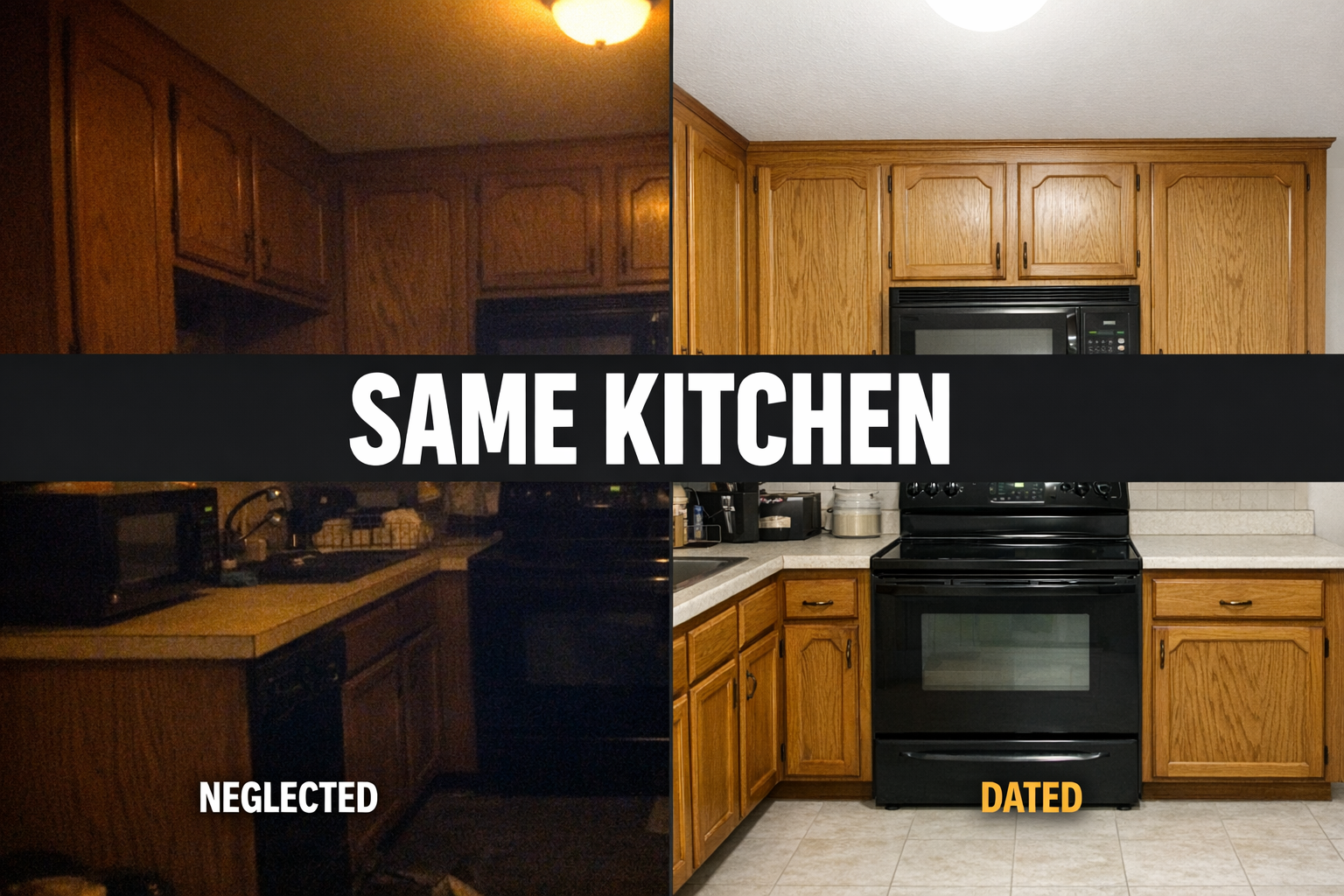
A bad photo doesn't make a dated house look dated. It makes it look neglected.
That's a different word, and the difference costs sellers real money.
Dated means old cabinets, old carpet, a bathroom from a decade nobody misses. Everybody understands what that is and roughly what it costs to change. It's a known number.
Neglected means something is wrong here. It means deferred maintenance. It means what else did they not take care of. It's an unknown number, and unknown numbers get discounted harder than known ones.
A buyer who thinks dated makes an offer. A buyer who thinks neglected either lowballs or moves on.
Why buyers assume the worse version
Here's the mechanism. A buyer cannot tell those two conclusions apart in a dark, crooked, badly white-balanced photograph. The information isn't in the image.
So they do what everyone does when they can't tell: they assume the worse case. Not because they're being unfair, but because the cost of being wrong in that direction is much lower. Guess "dated" on a neglected house and you've bought a money pit. Guess "neglected" on a dated house and you've passed on a deal — annoying, but survivable.
Given ambiguity, buyers price for risk. Every time.
The argument everyone makes backwards
The standard pitch for professional photography is built on beautiful homes. Better light, better angles, make the nice kitchen look nicer.
That's true, and it's the weaker version of the case.
A genuinely beautiful room photographs acceptably on a phone. The light is good, the finishes are new, there isn't much to misread. Which means the photography is contributing the least exactly where the property is contributing the most.
Now flip it. On a property that needs work, the ambiguity is enormous — and photography is the only thing that resolves it.
Shot properly, a dated kitchen reads as exactly what it is. A project. Something a buyer can attach a number to and make an offer around. Shot badly, that same kitchen reads as a warning.
So the photography premium is biggest precisely where agents are most likely to skip it.
The window test
Here's something you can check on your own listings in ten seconds.
Open any listing and look at the windows in the interior photos. If every window is a flat white rectangle with nothing visible outside, those photos were taken on a phone.
That's not a taste judgment, it's a physical limit. A phone captures a single frame, so it has to choose: expose for the window and the room goes dark, or expose for the room and the window blows out. It can't do both.
Professional shooting blends multiple exposures — bracketed frames, or bracketed frames plus flash — so the interior is evenly lit and you can see through the glass. That's the whole technical difference, and it's visible in every photo.
The reason it matters beyond the view: a room where the windows are white voids reads as darker and smaller than it actually is. Blown windows also flatten the corners, so the space looks cramped. Both of those get folded into what a buyer thinks the house is worth.
What the premium actually is
Redfin found that homes between $200,000 and $1 million sold for $3,400 to $11,200 more with professional photography than with amateur photos.
Buyers form their initial judgment about a listing in roughly 20 seconds.
Twenty seconds, on a house someone has owned for thirty years. And the floor of that premium range is seventeen times what a standard photo package costs.
Why the floor plan matters most on a rough property
The last piece, and it's the one that gets cut first.
On a house that needs work, the buyer is not purchasing the finishes. Those are coming out. They're purchasing the layout — where the walls are, whether the footprint works, what it costs to move things.
None of that is answerable from photographs. A buyer who can't price the job doesn't write an offer. They book a showing to go measure, or more often, they skip it and look at something they can evaluate from their couch.
That's why the floor plan belongs in the package on exactly the listings where it feels most skippable.
The short version
Dated is a known cost. Neglected is unknown risk. A bad photo turns the first into the second, and buyers price the difference.
If a listing is beautiful, good photography makes it look a little better. If a listing needs work, good photography is the difference between a project and a problem.
Frequently asked questions
How much does real estate photography cost in Chicagoland? Our Base package starts at $200 and includes 25 MLS photos, 6 drone photos and a floor plan. The Plus package at $300 adds a property walkthrough and basic cinematic video. Our Pro package at $450 includes a full cinematic video.
How long does a real estate photo shoot take? Most shoots run one to two hours on site, depending on square footage and whether video and drone coverage are included.
How fast do you deliver photos and video? Standard turnaround is 24 hours for photos and within 48 hours for video.
What areas do you serve? We work throughout Chicagoland, including Schaumburg, Arlington Heights, Elgin, Roselle, Stickney, Berwyn, Des Plaines, Park Ridge and the surrounding suburbs.
Book a shoot
Got a listing you think isn't worth shooting properly? Those are usually the ones that need it most.
See packages and book a shoot →
Related: There's No MLS Field for "Looks at Water" — the features that matter most usually have nowhere to live in the listing data.