

Buyers Rank the Neighborhood Above Price. Your Listing Video Never Shows It.
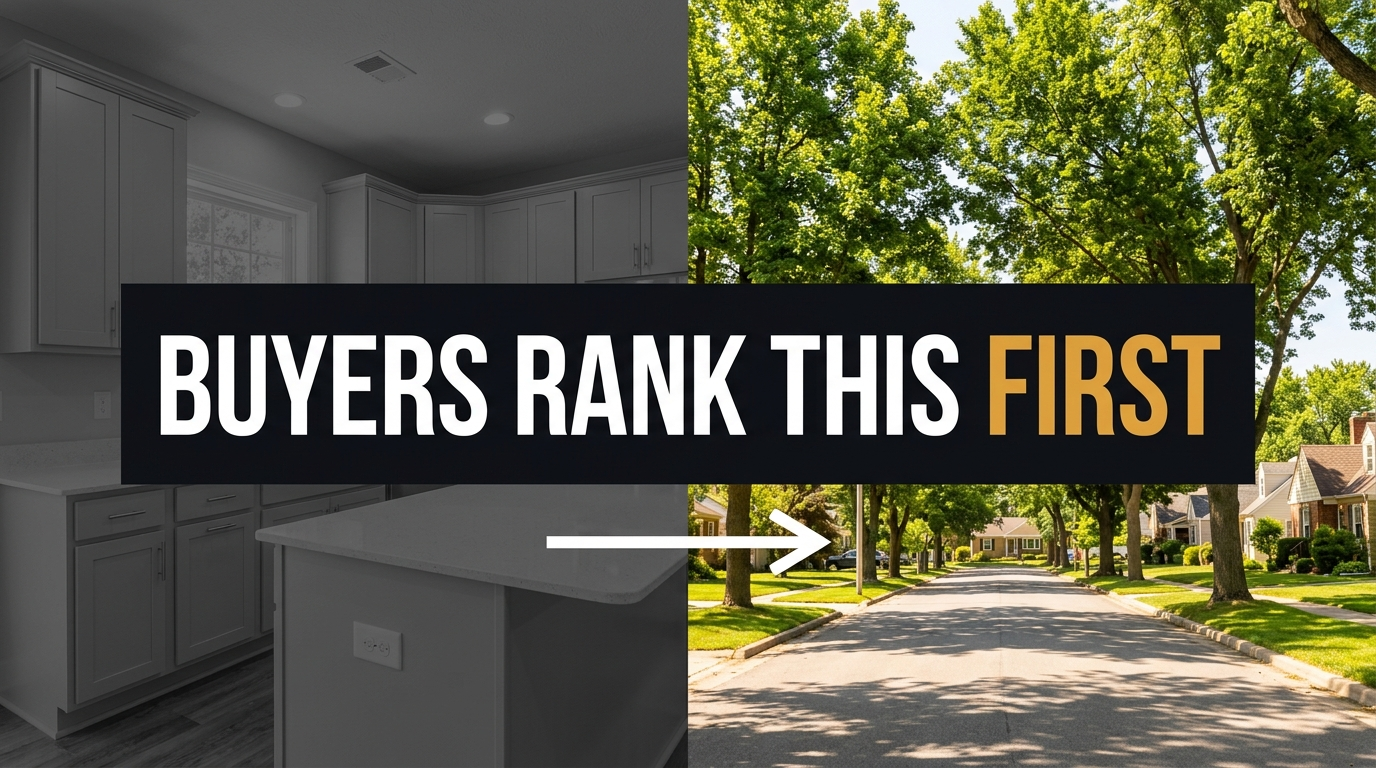
Fifty-nine percent of buyers say quality of the neighborhood is the most important factor in deciding where to buy. That's from the National Association of Realtors, and it puts the neighborhood ahead of price. Ahead of square footage. Ahead of every single feature inside the house.
A separate NAR survey from July 2026 found that 59% of people would take a smaller lot in a walkable neighborhood over a larger one that required more driving. Buyers are telling us, consistently and across every age group, that where a house sits matters more than what's in it.
Now go watch a listing video. Any listing video.
It opens on the front door. Kitchen, living room, bedrooms, bathroom. Maybe a drone shot of the roof. Then it ends. Count the seconds spent on anything past the property line and the answer is almost always zero.
We are producing marketing that ignores the thing buyers rank first and leads with the thing they rank third or fourth.
Why neighborhood footage gets skipped in listing videos
There's a practical reason, and it's not laziness.
Interior footage is efficient. One location, one afternoon, one setup, one drive. Neighborhood footage means multiple stops, more driving, sometimes permission, and a lot more time in the edit. It costs more, so it's the first thing cut from a quote.
That math makes sense for the person shooting. It doesn't make sense for the person selling.
What it costs you when the location is missing
Here's the part that actually matters.
A buyer watches your video. They like the kitchen. Then they open a new tab to figure out where the house is.
You just handed them off. You built attention, held it for ninety seconds, and then sent them to a map application at the exact moment they were most interested. Whatever happens next happens somewhere you don't control.
Every second they spend on a satellite view is a second not spent on your listing, your branding, or your contact information. And if what they find on that map is underwhelming — or if they just get distracted — you never get them back.
The fix isn't to hide the location. It's to answer the question inside your video, before they think to ask it.
The six-location structure we use
We keep it simple and repeatable.
Six locations, roughly ten seconds each, cut into the front of the video before any interior footage. Pick them by honest strength, not by what sounds impressive — a grocery store people actually use beats a landmark nobody visits.
A good six for a Chicagoland suburb usually looks like this: one genuinely surprising local landmark, one restaurant or coffee shop with real history in the area, one recreation option, one big-name retail anchor, one everyday errand stop, and one park or forest preserve. That last one matters more than it looks. Five straight parking lots reads like an ad for retail; one green frame breaks it up and makes the whole run feel like a place people live.
Tight geography matters more than variety. If everything on the list is within ten minutes, the shoot is one clean loop and the claim is credible.
Then the agent says one word at each stop. Not a speech. One word. It turns a list of places into a rhythm, and rhythm is what makes people finish a video.
When the location is the product
This structure matters most on the listings that are hardest to market.
When a unit is ordinary — dated kitchen, standard layout, nothing that photographs like a magazine spread — the neighborhood is the offer. A condo with a 1990s kitchen ten minutes from everything is a fundamentally different product than the same condo in the middle of nowhere. Only one of those two facts shows up in a standard walkthrough.
We shot exactly this in Schaumburg. The agent told us straight out that the unit wasn't the strong part of the listing, so we built the whole video around what surrounded it instead — a castle, a thirty-year-old pancake house, Topgolf, IKEA, the largest mall in Illinois, and a forest preserve, all inside a ten-minute radius. The unit became the payoff rather than the pitch.
She was right to call it. The best creative direction we got all month came from an agent telling us her listing was ordinary.
The house is the second decision. Stop making it the first thing you show.
Frequently asked questions
How much does real estate photography cost in Chicagoland? Our Base package starts at $200 and includes 25 MLS photos, 6 drone photos and a floor plan. The Plus package at $300 adds a property walkthrough and basic cinematic video. Our Pro package at $450 includes a full cinematic video. Multi-location neighborhood shoots are a $50 add-on to any video package.
How long does a real estate photo shoot take? Most shoots run one to two hours on site. A neighborhood video with six locations adds about ninety minutes, since we're driving a loop and setting up at each stop.
How fast do you deliver photos and video? Standard turnaround is 24 hours for photos and within 48 hours for video.
What areas do you serve? We work throughout Chicagoland, including Schaumburg, Roselle, Elgin, Arlington Heights, Des Plaines, Park Ridge, Crystal Lake and the surrounding northwest suburbs.
Book a neighborhood-first listing video
If your next listing is stronger on location than on finishes, that's not a weakness — it's a marketing decision waiting to be made. We can build the video around it.
See packages and book a shoot →
Related: Buyers Rank Photo Count Last. Here's What They Actually Want. — the floor plan episode, and the closest companion to this one.