

Removing a Laundry Basket Is Presentation. Removing a Defect Is Misrepresentation.
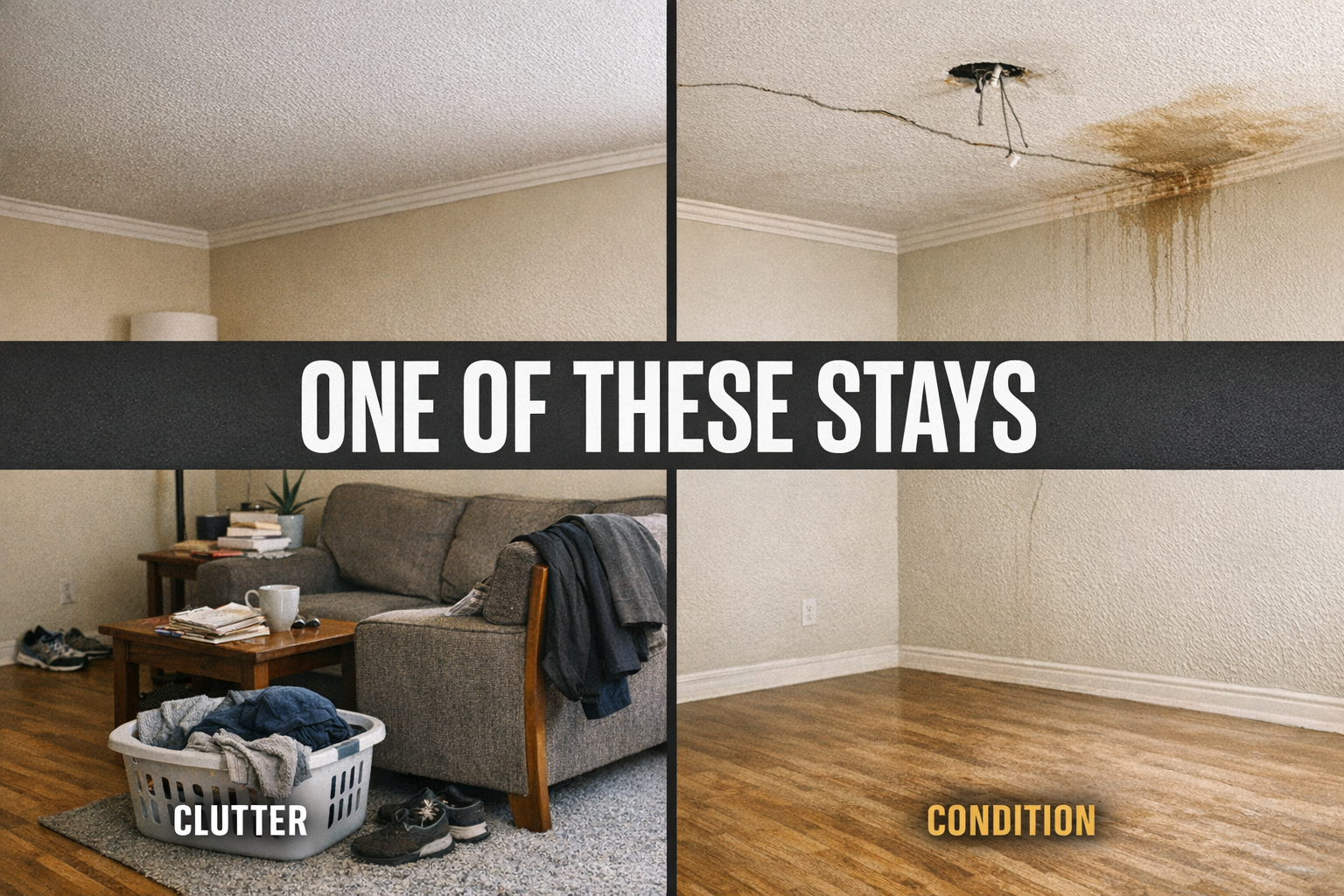
Removing a laundry basket is presentation. Removing a defect is misrepresentation.
Both of those happen with the same tool, in the same software, in about the same amount of time. They are not remotely the same act. One helps a buyer see a room. The other lies to them.
Watch this week's episode: Removing a laundry basket is presentation. Removing a defect is misrepresentation.
The test
One question, and it works on every edit:
Does this change how a buyer sees the space, or does it change what a buyer believes about the property?
That's it. Everything else follows from it.
What's presentation
A laundry basket is about the people living there right now. So is a dish rack, a stack of mail on the counter, a coat over the back of a chair, a kid's toy on the floor, shoes by the door.
None of that is a fact about the building. Take it out and the building is exactly what it was — same square footage, same layout, same condition, same everything a buyer is actually purchasing.
What removing it does is let someone look at the room instead of at somebody's life.
What's misrepresentation
A crack in the ceiling is a fact about the building. So is a water stain, a missing fixture, exposed wiring, a sagging soffit, a power line running over the yard.
Remove any of that and you've sent a buyer to a showing expecting a house that doesn't exist.
They find out in ten minutes, or they find out at inspection. Either way you've wasted their afternoon, damaged the agent's credibility, and created a problem at closing that nobody wanted. The defect was always going to surface. All the edit did was move the discovery to a worse moment.
The part that usually gets left out
Most of the industry argument about AI in listing photos assumes a vacant house, where physical staging is an available option and digital editing is a shortcut someone chose.
On an occupied property it often isn't available at all.
We shot a four unit building in Chicago this month. Four households, real people, real belongings, and no version of that afternoon where anybody clears out so a photographer can stage. That's normal for small multifamily. It's normal for plenty of occupied single family too — tenants have rights, sellers still live there, and a listing doesn't wait for an empty house.
So the practical choice isn't between physically staged and digitally edited.
It's between digitally edited and nothing.
And nothing means a buyer forming an opinion about a hundred-year-old building based on where somebody left their laundry. That isn't a fair read of the property either. A room full of another family's belongings doesn't tell a buyer anything true about whether the space works for them.
Why disclosure isn't a confession
There's a reflex to treat disclosure as an admission that something questionable happened. It's the opposite.
Disclosure is the thing that makes the first part legitimate. It tells a buyer exactly which category of edit they're looking at, so they can trust that the condition they see is the condition that exists. Without it, every edit becomes suspect — including the completely benign ones.
An agent who says "furniture and personal items were digitally removed; the property is shown in its existing condition" has given a buyer more useful information than one who says nothing and hopes.
Check your MLS rules on how that disclosure has to appear. They vary, and they've been changing.
Talking to a seller about it
Sellers usually ask one of two questions, and both have straightforward answers.
"Can you just make it look nicer?" Yes — we can remove your belongings so buyers see the room. We can't remove anything about the building's condition, because a buyer is going to walk through that door and it needs to match.
"Won't people be disappointed when they show up?" Not if the only thing that changed was your stuff. They'll walk in and find the same room, the same light, the same layout. The disappointment problem comes from editing condition, which is exactly what we don't do.
The short version
Clutter comes out. Condition stays. And it gets disclosed.
That line is easy to remember, easy to explain to a seller, and it holds up under every edge case we've run into.
Frequently asked questions
Do you offer AI decluttering and virtual staging? Yes. We remove furniture and personal belongings so buyers can see the space, and we do not alter anything describing the condition of the property. All AI edits are disclosed.
How much does real estate photography cost in Chicagoland? Our Base package starts at $200 and includes 25 MLS photos, 6 drone photos and a floor plan. The Plus package at $300 adds a property walkthrough and basic cinematic video. Our Pro package at $450 includes a full cinematic video.
How fast do you deliver photos and video? Standard turnaround is 24 hours for photos and within 48 hours for video.
What areas do you serve? We work throughout Chicago and the surrounding suburbs, including Calumet Heights, Berwyn, Cicero, Stickney, Schaumburg, Arlington Heights, Elgin and Roselle.
Book a shoot
Got an occupied listing you've been putting off? That's a specific problem and we have a specific answer for it.
See packages and book a shoot →
Related: A Homebuyer Wants the Kitchen. An Investor Wants the Meters. — the multifamily building this episode uses as its case study.